


Morocco's Best Beach Destinations — Sun, Surf & Atlantic Escapes
Morocco's best beaches for every traveller: Agadir, Essaouira, Dakhla, Taghazout, Saidia and El Jadida — with driving directions, best months and what makes each unique.
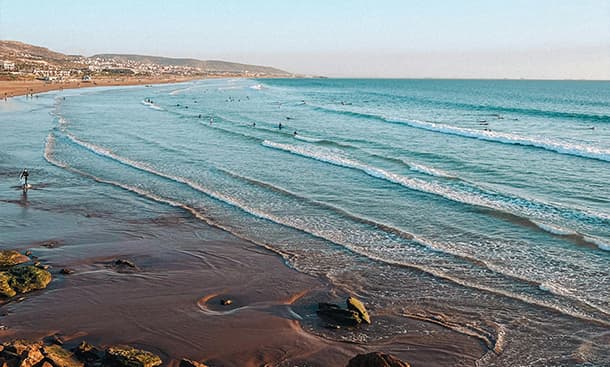
Morocco's coastline is one of its least-discussed assets and one of its greatest. Over 3,500 km of shore split between the Atlantic Ocean to the west and the Mediterranean Sea to the north gives the country a coastal range that few places in Africa or the Middle East can match. The Atlantic side is powerful and wind-driven — great for surfers, kitesurfers, and anyone who wants a beach that does not feel crowded. The Mediterranean side is warmer, calmer, and more suitable for families. With a rental car you can reach beaches that no bus schedule serves, drive the coast at sunrise before anyone else is there, and combine a beach stop with an inland detour in the same afternoon.
Agadir — Morocco's premier beach resort: Agadir's beach stretches for nearly 10 km along a deeply sheltered bay, making it one of the longest and most protected Atlantic beaches in Africa. The town was completely rebuilt after the catastrophic earthquake of 29 February 1960, which killed between 12,000 and 15,000 people in under 15 seconds, and the modern city that rose from the ruins is Morocco's most infrastructure-ready beach destination: wide beachfront promenades, reliable services, international-standard accommodation across all budgets, and direct flights from across Europe on every major low-cost carrier. The Atlantic swell here is consistent but moderate thanks to the bay's natural shelter, making it ideal for families with children, swimmers of all levels, and beginner surfers. Average summer temperatures hold between 24 and 28°C thanks to the Canary Current — cooler than Marrakech by 15 degrees on a July afternoon. Agadir is also the departure point for excellent day trips: the Souss-Massa National Park (50 km south, home to the endangered Northern Bald Ibis), Paradise Valley (a lush palm gorge 40 km inland on the road to Imouzzer), and the argan oil cooperatives of the Chiadma plateau. Best months: May to October.
Essaouira — Atlantic bohemia and the wind capital: Essaouira sits 175 km north of Agadir on the Atlantic coast, and the drive between the two along the R301 coastal road is one of Morocco's most rewarding — argan trees, cliff-top viewpoints, fishing villages, and the Atlantic all the way. The medina of Essaouira is a UNESCO World Heritage Site inscribed in 2001, a rare example of a late 18th-century fortified port town that has retained its original layout: Portuguese-influenced ramparts, whitewashed walls with blue shutters, and a grid-plan medina built by French architect Théodore Cornut under Sultan Sidi Mohammed ben Abdallah. The beach runs for over 10 km south of the ramparts, and the trade winds (alizés) that funnel through the bay are reliable and powerful year-round — Essaouira has hosted the PWA Windsurfing World Cup and is consistently rated among the top ten windsurfing and kitesurfing destinations on earth. The same winds that thrill kite- and windsurfers make sunbathing challenging from June to August, but the town itself — its fish restaurants, argan wood workshops, blue fishing boats, and rampart walks at sunset — is at its most vibrant in summer. Best months for water sports: year-round. Best months for a beach holiday without wind: March–May and September–October.
Dakhla — the kiteboarder's paradise at the end of the road: Dakhla occupies a narrow peninsula 540 km south of Agadir, deep in Morocco's southern Atlantic coast, and its lagoon is one of the most celebrated kiteboarding and windsurfing venues on the planet. The lagoon — a UNESCO biosphere reserve — provides flat, shallow water on one side and exposed Atlantic swells on the other, making it the only place in Morocco where flat-water freestyle kiteboarding and wave riding coexist within a few kilometres of each other. The microclimate is exceptional: temperatures rarely exceed 28°C in summer and rarely fall below 18°C in winter, the trade winds are reliable from April to October, and the flamingos that feed in the shallower areas of the lagoon turn the sunset views pink. The drive from Agadir to Dakhla on the N1 is long — plan for five to six hours of driving through flat Saharan coast, with fuel stops at Tiznit (90 km), Guelmim (200 km), and Tan-Tan (360 km). The reward at the end is a destination unlike anywhere else in Morocco: a frontier town with world-class conditions, fresh seafood, and an end-of-the-world atmosphere that draws kitesurfers, fishermen, and overlanders from across Europe and beyond. Best months: April to October for wind sports; year-round for the atmosphere.
Taghazout and Paradise Valley — the surf village: Taghazout is a former fishing village 18 km north of Agadir on the coastal road (R301), and it is Morocco's surf capital. The point breaks that wrap around the headland here — Anchor Point, Hash Point, Killer Point, and Panoramas — are among the most consistent right-handers in Africa, producing long walls suitable for intermediate and advanced surfers from October through April. Anchor Point in particular, when a solid North Atlantic swell arrives, produces rides of up to 300 metres and is considered by many surfers to be one of the top five point breaks outside of Indonesia and Portugal. The village has grown rapidly in the past decade and now has a full ecosystem of surf camps, yoga retreats, health cafés, and board rental shops. From May to September the swell flattens and Taghazout shifts from surf village to beach holiday destination, quieter and far less crowded than Agadir. Combine a Taghazout stop with a detour to Paradise Valley — 20 km inland from Agadir on the Imouzzer road — a dramatic palm-lined gorge with natural rock pools fed by mountain springs, perfect for a midday swim after a morning surf session.
Saidia and El Jadida — the hidden gems: Saidia, in Morocco's far northeast near the Algerian border, is the country's largest Mediterranean beach resort and one of its least visited by international travelers. The beach extends for over 14 km of fine white sand with calm, warm Mediterranean water that is perfect for families — the absence of Atlantic swell makes it the gentlest swimming beach in Morocco. The town has developed considerably since the early 2000s with a marina, two golf courses, and international hotel complexes, and it is extremely popular with Moroccan families in July and August. Access from Oujda airport (A2 motorway, 25 km) is easy. Best months: June to September. El Jadida, 90 km south of Casablanca, offers something different: a UNESCO-listed Portuguese city (the Cité Portugaise, inscribed 2004) combined with a long Atlantic beach backed by pine forests. The interior of the Portuguese cistern — a vaulted underground chamber built in the early 16th century, its arched stone ceiling reflected in a shallow pool of water on the floor — is one of the most photographed interiors in Morocco and worth the drive alone. The beach at El Jadida is popular with Casablancans on summer weekends, easily reached on the A5 motorway in 45 minutes. Combine with a stop at Moulay Abdallah, a small coastal town 10 km south with a good beach and a famous annual moussem (religious festival).